
Gusta Meaning in Spanish: Me Gusta vs. Gusto Explained
The gusta meaning in Spanish trips up almost every beginner, and it’s not because the word is hard it’s because Spanish flips the whole sentence around. If you’ve ever written “yo gusto” trying to say “I like,” and gotten a confused look back, you’re not alone; it’s one of the most common early mistakes learners make. I’ve watched this exact confusion happen in real conversations, and it usually comes down to one thing: gustar doesn’t work like the English verb “to like” at all.
This guide breaks down the gusta meaning, how it differs from gusto and gustó, and why the subject of the sentence in Spanish isn’t the person it’s the thing being liked. By the end, you’ll be able to use me gusta, me gustan, gusto, and gustó correctly in real conversations, without translating word-for-word from English in your head.

Table of Contents
What Does “Me Gusta” Mean in Spanish?
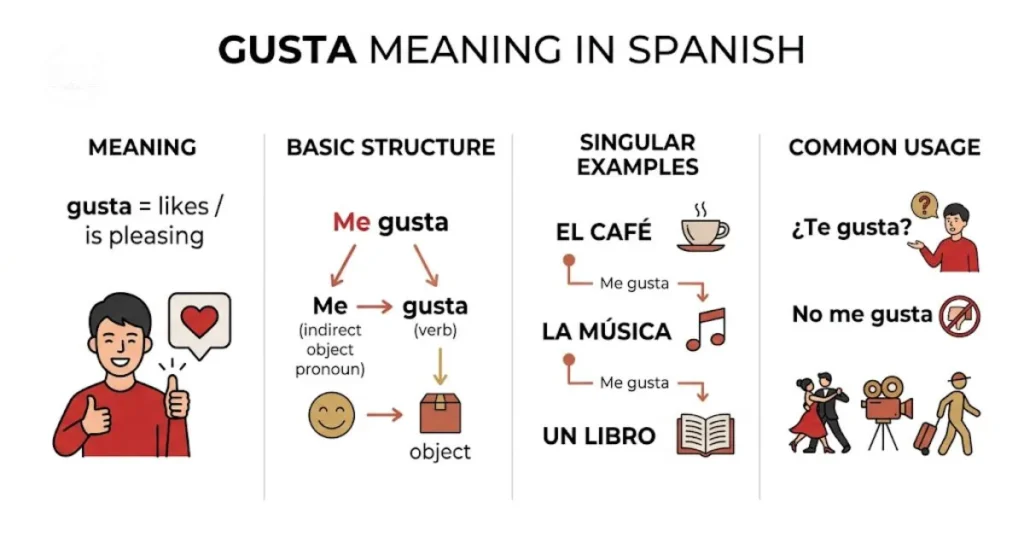
Me gusta literally means “it pleases me,” even though English speakers translate it as “I like it.” This reversal is the entire key to understanding gustar and every verb that behaves like it. The thing you like becomes the grammatical subject, not the person doing the liking, which feels backwards at first but becomes automatic with repetition.
That’s why “me gusta el café” doesn’t mean “I like coffee” word for word, it means “coffee pleases me.” Native speakers rarely think about this literal translation; they just feel the pattern. Spanish learners benefit from slowing down here, since this single shift in sentence structure explains almost every gustar-related mistake later on.
The Grammar Behind Gustar: Why Spanish Works Differently Than English
Spanish sentences with gustar follow an object-verb-subject order instead of the subject-verb-object pattern English speakers default to. The indirect object pronoun (me, te, le, nos, os, les) tells you who is experiencing the liking, while the noun after gustar is the true subject. This inversion is the core semantic reason gustar confuses new learners.
Once you accept that gustar behaves like “to please” rather than “to like,” the conjugation logic falls into place naturally. The verb agrees with whatever is pleasing a book, a song, a person not with the speaker. This one grammar shift also unlocks other Spanish verbs like encantar and molestar, which follow the same pattern.
Me Gusta vs. Me Gustan: What’s the Difference?
Me gusta and me gustan differ by number, not by who is doing the liking. Gusta pairs with a singular noun or an infinitive verb, while gustan pairs with a plural noun, because the verb conjugates to match its true subject. This is the single most frequent gustar error among English-speaking learners.
Think of it this way: “me gusta la playa” (I like the beach) uses gusta because playa is singular, while “me gustan las playas” (I like beaches) shifts to gustan because playas is plural. The pronoun me never changes here only the verb form does, based entirely on what’s being liked.
What does “me gustas” mean?
“Me gustas” means “I like you” (romantically or as a person), using the “tú” form. Note the verb ending “-as” changes based on who is being liked, not who is doing the liking “gustar” grammatically works like “you appeal to me.”
How do I respond to “me gustas”?
Depends on your feelings:
- If you feel the same: “Tú también me gustas” (I like you too) or simply “Igualmente” (Likewise).
- If you’re unsure or want to be gentle: “Gracias, eres muy dulce” (Thanks, you’re very sweet) or “Me caes muy bien” (I like you a lot as a friend softer, less romantic).
- If you don’t feel the same: “Te agradezco, pero no siento lo mismo” (I appreciate it, but I don’t feel the same way).
How do Mexicans say “I love you”?
The standard phrase is “Te amo” used for deep, romantic love (partners, sometimes family). “Te quiero” is also very common and slightly less intense used for partners, close friends, and family, similar to “I love you” but with a warmer, more casual feel than “te amo” in some contexts.
Final Thoughts
Understanding the gusta meaning really comes down to accepting one strange but consistent rule: in Spanish, things please you rather than you liking things. Once that flips in your head, me gusta, me gustan, gusto, and gustó stop feeling like four separate problems and start feeling like one pattern with small, predictable variations.
Keep listening to gustar in real Spanish songs, shows, conversations and the object-verb-subject order will start sounding natural long before you can explain it grammatically. That’s usually how this particular piece of Spanish finally clicks, not from memorizing rules, but from hearing them enough times that they stop sounding backwards.
FAQs
Author

Ethan Carter is a search engine optimization blogger focusing on web slang, text content abbreviations, and social media implications. He creates clean, accurate, and reader-friendly content backed by using thorough research. Its purpose is to help readers understand modern online language with reliable, flexible publications.





2 Comments