What Does PS Mean? Meaning, Origin & Uses (With Examples)
PS stands for “post scriptum,” a Latin phrase meaning “written after,” and it marks an extra thought added below your signature. If you’ve ever reached the end of an email and wondered what does PS means, you’re in good company. I’ve watched smart professionals hesitate over those two letters, unsure whether they sound charming or careless.
This guide explains the PS meaning, its Roman roots, correct punctuation, and how people use it in letters, texts, captions, and marketing copy. After years of editing emails and sales pages, I’ve learned that one well-placed postscript can change how a reader responds. You’ll leave knowing exactly when to use it and when to skip it.
What Does “PS” Mean? (Quick Answer)
PS stands for post scriptum, Latin for “written after.” It’s a short note added after the main message and signature, usually holding an afterthought, reminder, or friendly extra. Think of it as a postscript: a final line that sits apart from the body of a letter or email.
In everyday English, you’ll see it written as PS or P.S., and a second addition becomes P.P.S. Today the abbreviation shows up in emails, texts, captions, and sales letters, but the core meaning hasn’t changed. It signals one more thing the writer wants you to notice.
Post Scriptum Meaning: Understanding the Latin Root
Post scriptum combines two Latin words. Post means “after,” and scriptum, from the verb scribere, means “written.” Put together, the phrase literally reads “written after,” which explains why a postscript traditionally appears below the signature, after the writer believed the letter was finished.
English borrowed the term long ago, and “postscript” now works as an ordinary noun. You can say “I added a postscript” without any Latin flair. Knowing this root makes the abbreviation easier to remember and explains why the note always sits at the very end.
Origin and History of “P.S.”
Long before email, letter writers had no backspace key. If someone forgot a detail after signing, they squeezed it below the signature instead of rewriting a costly sheet of paper. Postscripts appear in ancient Roman correspondence, which is why the habit feels both old-fashioned and strangely familiar.
As letter writing spread across Europe and North America, “P.S.” became a standard convention, and “P.P.S.” followed for further additions. When typewriters and word processors made editing easy, the postscript survived anyway. It shifted from a practical fix into a deliberate style choice.
Basic Definition of PS in English Writing
In English writing, a PS is a brief addition placed after the closing and signature of a letter, email, or note. Dictionaries define it as a postscript: an extra remark that supplements the main text without being part of its original structure.
Because it sits outside the body, a PS works best for something short, such as a reminder, a joke, or an extra detail. Writers treat it as an afterthought on purpose. That makes the content feel personal, spontaneous, and easy to remember.
PS vs P.S.: Which Spelling Is Correct?
Both are correct. P.S. with periods is the traditional form, while PS without periods has become common in digital writing because it’s faster to type. Some style guides lean toward PS without periods, so check the manual your publication follows and then stay consistent.
Capitalize it either way. Lowercase “ps” appears in casual texting, but it looks careless in formal writing. A colon after it, as in “P.S.:” or “PS:”, is also acceptable if it improves readability. Whatever you choose, use the same format throughout one document.
How to Use “P.S.” in Letters
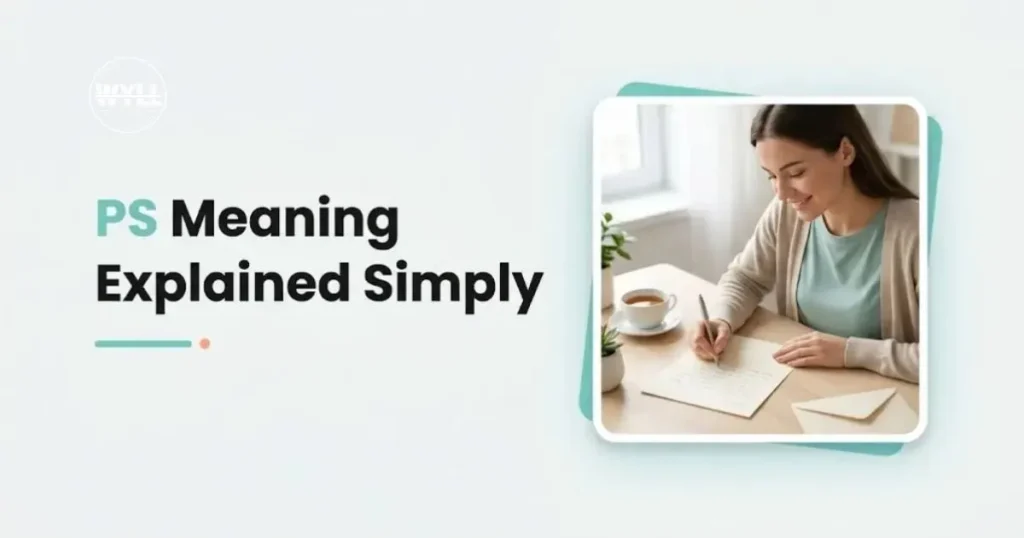
In a letter, finish the body, add your closing and signature, then skip a line and write P.S. followed by your note. Handwritten letters still follow this order, because the postscript is meant to appear after everything else, exactly where a curious reader’s eyes land last.
Keep it to one or two sentences. A friendly reminder, a warm sentiment, or a small joke fits well in personal letters. For business letters, reserve it for genuinely useful details, and avoid cramming new main points into a postscript that readers might skim past.
What Does “P.S.” Mean in Emails?
In emails, P.S. carries the same meaning: a note added after your signature or closing line. People use it to add a reminder, link, deadline, or personal touch. Email’s flexibility means the postscript often feels like a casual aside rather than a formal part of the message.
Here’s a simple example: “P.S. I can’t wait to see you next week.” It’s brief, warm, and clear. Since editing is effortless in email, a P.S. today is rarely a correction. It’s a deliberate way to highlight one last point that deserves attention.
Why Is “P.S.” Still Used in Emails Today?
You can edit an email endlessly, so why keep the P.S.? Because it works psychologically. Readers often scan messages, and a short line after the signature stands out. Writers use it to emphasize a call to action, a deadline, or a personal note.
It also adds tone. A postscript can soften a formal request, show humor, or make a message feel handwritten. Marketers and newsletter writers rely on it because many readers glance at the end first, though results vary, so test it against your own audience.
What Does “PS” Mean in Text Messages?
In text messages, PS still means “postscript,” an afterthought added after your main message, like “ps bring snacks.” People often write it in lowercase and skip the periods because texting rewards speed. The tone is casual, playful, and usually signals a quick extra detail.
Be careful with context, though. In gaming chats, PS may refer to PlayStation, and in design talk it can mean Photoshop. If a PS appears at the start of a message instead of the end, check the topic before assuming it’s a postscript.
PS Meaning in Social Media Posts and Captions
On Instagram, X, Facebook, and TikTok, people use PS at the end of captions for a closing joke, a reminder to follow, or a link note. It gives a post a conversational voice, like a whispered aside after the main announcement.
Because captions are short, a PS should add something fresh rather than repeat the caption. Creators often use it for promo codes, event dates, or personality. Keep it consistent with your brand voice, and avoid stacking several PS lines that make the post feel cluttered.
Common Uses of “P.S.”
People use P.S. in several ways: adding a forgotten detail, reinforcing an important point, sharing a personal sentiment, or inserting humor. In love letters and thank-you notes, it often carries the warmest line, the thing the writer most wanted to say last.
In professional contexts, a P.S. may highlight a deadline, attach a call to action, or offer a courteous extra. Teachers, fundraisers, and small business owners all use it because it separates one memorable idea from the rest of the message without needing a new paragraph.
P.S. in Marketing and Sales Copy
Direct-response copywriters have long treated the P.S. as prime real estate. In a sales letter, it often restates the main benefit, the deadline, or the guarantee, because skimmers frequently jump from the headline to the signature. Many copywriting guides call it one of the most-read parts.
A strong marketing P.S. is specific and action-oriented, such as “P.S. Order by Friday and shipping is free.” Avoid vague hype. Tie it to the offer, create honest urgency, and test variations in email campaigns to see whether it actually lifts clicks.
PPS Meaning: What Does “P.P.S.” Stand For?
P.P.S. stands for post post scriptum, meaning “written after the postscript.” It’s a second afterthought added below the first P.S. You may also see P.P.P.S., though stacking more than two quickly looks unplanned and can weaken your message.
Writers use P.P.S. playfully or for a final nudge, such as a reminder after a joke. In sales letters, it can repeat the offer’s deadline. Use it sparingly, and only when the extra line gives the reader something genuinely worth reading.
| Abbreviation | Full Latin | Meaning | Typical Use |
| P.S. | Post scriptum | “Written after” | First afterthought or key reminder |
| P.P.S. | Post post scriptum | “Written after the postscript” | Second afterthought or final nudge |
PS Examples in Context
Personal: “P.S. Don’t forget to bring the photo album on Sunday.” Professional: “P.S. The registration link closes Friday at noon.” Both are short, specific, and useful. A good postscript sounds like something you just remembered, even when you planned it carefully.
Casual text: “ps your playlist is so good.” Marketing: “P.S. Your 15% code expires tonight.” Playful: “P.S. I still owe you coffee.” Notice each example carries one idea, one tone, and one clear takeaway for the reader.
How to Write a Good P.S. (Step-by-Step Tips)
Start by deciding the purpose: reminder, emphasis, humor, or warmth. Then write one or two sentences, no more. Choose your format, either PS or P.S., and place it after your signature. Read it aloud to make sure it sounds natural, not forced.
Finally, check the tone against the relationship. A friendly joke suits a friend but may confuse a new client. Make sure the postscript adds value instead of repeating the body, and edit ruthlessly so the final line lands cleanly and memorably.
Where to Place the P.S. in a Message
Place the P.S. after your closing and signature, separated by a blank line. That placement is what makes it a postscript. In an email, it usually goes right below your name, before any long automatic signature block, banner, or legal disclaimer.
Putting a P.S. inside the body defeats its purpose and can confuse readers. If you’re writing on paper, add it below your signature. In texts and captions, put it at the very end so it reads like a genuine final thought.
Dos and Don’ts of Using “P.S.”
Do keep it short, specific, and relevant. Do use it for one memorable point, a warm note, or a clear call to action. Do match your tone to your reader, and use a consistent format such as P.S. throughout so the message looks polished.
Don’t bury essential information there, since some readers skip it. Don’t use it in every email, or it loses impact. Don’t write long postscripts, and avoid it in highly formal correspondence like legal notices, where it may come across as unprofessional.
Common Mistakes to Avoid When Using PS
The most common mistake is putting critical information in the P.S. that belongs in the main message. Another is writing a long paragraph, which stops it from feeling like an afterthought. Inconsistent punctuation, such as mixing PS and P.S. in one email, also looks sloppy.
People also forget the audience. A jokey P.S. in a formal cover letter may backfire, and overusing P.P.S. can seem forced. Finally, don’t confuse PS with other meanings like PlayStation or Photoshop when context points elsewhere. Proofread for clarity before sending.
Modern Adaptations of “P.S.”
The postscript has adapted to digital life. Writers use lowercase “ps” in texts, add “PS:” in newsletters, and craft clickable P.S. lines in email campaigns. Some online writers use “edit:” or “update:” in social threads, which serves a similar purpose after posting.
Brands also use P.S. creatively, adding links, promo codes, and personality below the signature. Though the format shifts across platforms, the function stays the same: a final, memorable line that sits apart from the main message and rewards readers who reach the end.
PS Meaning in Other Fields
Outside writing, PS can mean many things. PlayStation is common in gaming, and Photoshop in design. In New York City, P.S. followed by a number identifies a public school. In German, PS stands for Pferdestärke, or horsepower, and in the Bible “Ps.” abbreviates Psalms.
PS can also mean power steering in automotive talk, and PostScript is Adobe’s page-description language from the 1980s. Context matters. The surrounding words, platform, and audience usually reveal whether someone means a postscript or something entirely different.
| Field | PS Means | Example |
| Writing | Postscript | “P.S. See you soon!” |
| Gaming | PlayStation | “I’m playing on PS5.” |
| Design | Photoshop | “Edit it in PS.” |
| Education (NYC) | Public School | “P.S. 321” |
| Automotive | Power steering | “PS fluid check” |
| German | Pferdestärke (horsepower) | “150 PS” |
| Religion | Psalms | “Ps. 23” |
Is “P.S.” Formal or Informal?
P.S. leans informal to semi-formal. It’s perfectly fine in personal letters, friendly emails, and marketing messages, where warmth and personality help. In highly formal contexts such as legal notices, academic submissions, or executive reports, it may feel too casual, so choose carefully.
The safest rule is to consider your reader. A cover letter or business proposal usually reads better with every point in the body, while a note to a colleague you know well can comfortably handle a light, friendly postscript at the end.
Synonyms and Alternatives to “P.S.”
Alternatives include “postscript,” “afterthought,” “addendum,” “one more thing,” and “by the way.” N.B., short for nota bene (“note well”), is related but flags importance rather than an afterthought. Online, “edit,” “update,” and “BTW” often do similar work in comments and posts.
Another alternative is simply placing the information in the body, which is often best for important details. “Also,” “quick note,” and “just remembered” work in conversational emails. Choose the option that matches your tone and where the detail genuinely belongs in the message.
PS Translations in Other Languages
Many languages borrow the Latin abbreviation. Spanish writers use P.D. for posdata, French writers use P.-S. for post-scriptum, and Italian uses P.S. In German, PS is also recognized as Postskriptum, though it shouldn’t be confused with horsepower in car contexts.
Portuguese also commonly uses P.S. For international emails, P.S. is widely understood among English speakers, but a localized form can feel more natural and show respect for the reader’s language. When in doubt, match the convention of the recipient’s country.
Fun Facts About “P.S.”
The best-known pop culture P.S. may be “P.S. I Love You,” Cecelia Ahern’s 2004 novel, which became a 2007 film. The title shows how a postscript can carry the emotional punch of an entire story in one last line.
The word “postscript” also names Adobe’s PostScript language, which is closely tied to the history of printing and PDFs. And because it literally means “written after,” even a modern text with a late “ps” connects you to centuries of letter writers who squeezed in a final thought.
Conclusion:
So, what does PS mean in practice? It’s a small Latin leftover that still earns its place: a quick, human line after your signature. Use it when you have one memorable idea, a warm touch, or a call to action that deserves the final spot in the message.
Skip it in strict formal documents, keep it short, and stay consistent with punctuation. Done well, a postscript feels like a smile at the door as the reader leaves. Try one in your next email, then notice how it changes the conversation and what readers remember.
“PS I Love You” usually means “P.S., I love you” an extra loving message added at the end of a text, letter, or note.
FAQs
Author

Ethan Carter is a search engine optimization blogger focusing on web slang, text content abbreviations, and social media implications. He creates clean, accurate, and reader-friendly content backed by using thorough research. Its purpose is to help readers understand modern online language with reliable, flexible publications.