
NTP Meaning Spanish: What “No Te Preocupes” Means in Text
Receiving a quick 3-letter acronym like “NTP” in a Spanish textual content can immediately cause confusion if you aren’t acquainted with local virtual shorthand. The specific NTP meaning in Spanish translates without delay to “no te preocupes” which means “do not worry”or “no problem” in English. As native audio systems throughout WhatsApp and social media ditch full sentences for rapid typing, understanding these compact informal Spanish expressions will become critical for seamless online messaging.
This whole manual breaks down the appropriate pragmatic usage of Spanish net acronyms so you can speak evidently. Drawing from real-world digital chat etiquette, we are able to look at context-particular examples, regional variations, formal options, and not unusual complementary slang like “ntc” or “npn”
What Is the NTP Meaning in Spanish Texting?
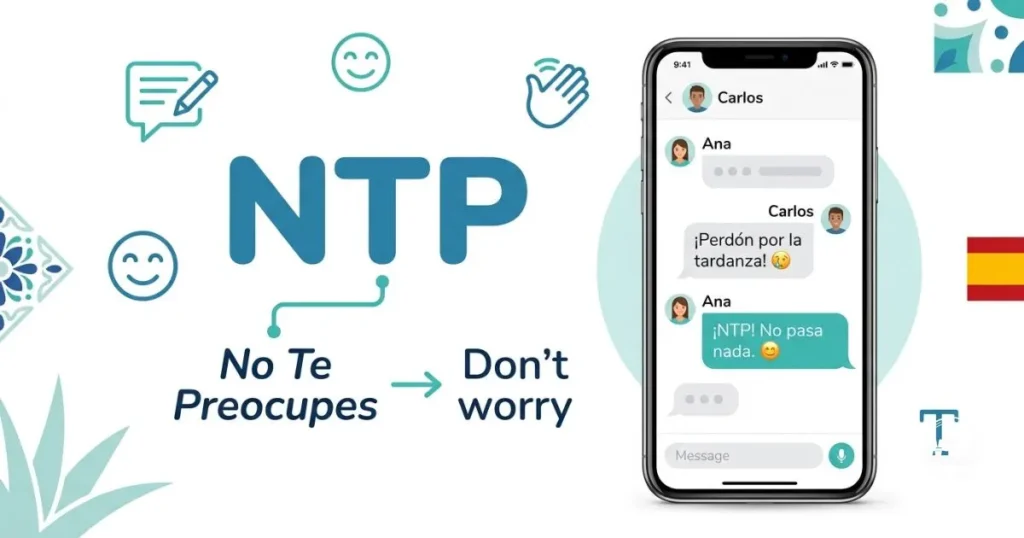
The acronym NTP is the typical Spanish texting abbreviation for the word “no te preocupes,” which translates to “do not worry in English. Native audio systems rely on this shorthand in casual Spanish expressions across WhatsApp, Instagram, and SMS to keep asynchronous messaging fast, pleasant, and clean.
This popular Spanish slang serves as a direct reassurance mechanism whilst a person apologizes for a minor put off or mistake. By dropping the total grammatical structure, the sender uses virtual chat etiquette to instantly sign empathy, ease anxiety, and preserve a comfortable, friendly tone.
How to Use NTP in Real-World Spanish Conversations
Applying NTP effectively requires knowledge its role as a brief, supportive conversational reset in casual texting. It acts as an instant conversational Spanish textual content response while a friend expresses remorse over minor agenda shifts or not on time replies.
Applying NTP correctly requires understanding its role as a quick, supportive conversational reset in casual texting. It acts as an instant conversational Spanish text response when a friend expresses regret over minor schedule shifts or delayed replies.
[Friend] ───> “Lo siento, voy 5 min tarde!” (Sorry, 5 mins late!)
│
▼
[You] ───> “NTP, aquí te espero!” (NTP, waiting here!)
When you use “no te preocupes” in its abbreviated shape, you keep high emotional intelligence without overthinking spelling. It smooths over small social frictions in fast-paced institution chats, maintaining the dialog light and conversational.
Texting Friends and Peers
In casual texts with friends, NTP functions as an unbroken phonetic shortcut to push aside minor apologies. For instance, if a friend texts “Perdón por contestar tarde” (Sorry for replying late), replying with “NTP, todo bien” instantly validates their message at the same time as maintaining the vibe relaxed.
Cultural Context and Regional Usage of No Te Preocupes
The word “no te preocupes” is universally recognized throughout the Spanish-talking world, from Mexico and Colombia to Spain and Argentina. However, nearby Spanish textual content slang often layers extra nearby flair along the usual acronym.
While Latin American youth heavily favor NTP on social media platforms, Peninsular Spanish speakers often pair it with “no pasa nada” (npn). Understanding these cultural nuances helps learners recognize text-based empathy across different Spanish-speaking populations.
Formal vs Informal: When NOT to Use NTP
Because NTP makes use of the casual second-man or woman pronoun (tú), it’s strictly an informal expression meant for pals, circle of relatives, and peers. Using this shorthand in a professional placing can stumble upon as overly informal or unprofessional.
Use formal full phrase: Use casual abbreviation:
“No se preocupe” “NTP” (No te preocupes)
In corporate communications, email exchanges with clients, or conversations with elders, continually drop the acronym.Opt instead for the complete, respectful formal imperative conjugation to maintain proper professional decorum.
Using No Se Preocupe in Professional Contexts
In enterprise environments, update informal acronyms with the polite formal word “no se preocupe” (the use of the usted shape). Typing out the overall formal phrase demonstrates admiration, professionalism, and high pragmatic language requirements during client communications.
Common Spanish Text Slang Paired with NTP
To communicate like a native speaker, it enables one to study the broader community of Spanish internet acronyms often used alongside NTP. Native audio systems frequently combine those shorthand phrases in unmarried messaging threads to express layered feelings.
| Acronym | Full Phrase | Primary Usage |
| NTC | No te creas | “Just kidding” / “Don’t take it seriously” |
| NPN | No pasa nada | “No problem” / “It’s all good” |
| GPI | Gracias por invitar | “Thanks for the invite” |
| XFA | Por favor | “Please” |
| ASK | A saber qué | “Who knows” / “God knows” |
Combining “NTP” with phrases like “NTC”(no te creas) or “NPN”(no pasa nada) creates a herbal digital rhythm. Mastering those paired abbreviations permits you to navigate Spanish online communities with genuine fluency.
How to Respond to NTP in Spanish Texting
When someone sends you NTP in reaction to an apology or replacement, acknowledging their message closes the conversation loop gracefully. A brief follow-up keeps herbal conversational glide without dragging out the alternative.
[ You ] ───> “Llego en 10 minutos!” (Arriving in 10 mins!)
│
▼
[ Friend ] ───> “NTP!” (No te preocupes!)
│
▼
[ You ] ───> “Gracias! / Dale!” (Thanks! / All right!)
Appropriate brief responses consist of “Gracias” (Thank you), “Dale” (All right / Go beforehand), or “Te aviso cuando llegue” (I’ll let you know when I arrive). These simple replies make sure clear, well mannered closure in daily chat exchanges.
NTP Meaning Spanish vs Technical NTP Protocols
It is critical to differentiate the NTP meaning in Spanish textual content messaging from the technical computing term NTP. In network engineering and IT contexts, NTP stands for Network Time Protocol, a system used to synchronize computer clocks across networks.
| Context | Stand-For Meaning | Domain / Application |
|---|---|---|
| Spanish Texting | No te preocupes | Social Chat / Messaging |
| Network Engineering | Network Time Protocol | Computer Clock Sync |
While software program structures depend upon Network Time Protocol for correct timestamp logging, actual-world Spanish speakers use NTP strictly as conversational shorthand for “no te preocupes.” Context without difficulty clarifies which means applies.
Conclusion
Understanding the true NTP that means in Spanish unlocks smoother, greater genuine digital conversations throughout the Spanish-speaking world. By recognizing that NTP stands for “no te preocupes,” you can effectively offer reassurance in informal texts, build stronger connections with native speakers, and navigate casual messaging with confidence.
FAQs
AUTHOR

Ethan Carter is a search engine optimization blogger focusing on web slang, text content abbreviations, and social media implications. He creates clean, accurate, and reader-friendly content backed by using thorough research. Its purpose is to help readers understand modern online language with reliable, flexible publications.