

Dear Team Meaning: What This Email Greeting Really Says
You open a new work email and it starts with “Dear Team.” Nothing about it feels wrong, but you might still wonder what it actually signals is it warm, distant, old-fashioned, or exactly right? Understanding email salutation meaning matters more than people admit, because a greeting sets the emotional register before a single sentence of content arrives. Get it wrong and a message can feel cold or oddly formal; get it right and the reader relaxes into what follows.
This article breaks down what “Dear Team” really communicates, where it came from, how professionals use it today, and when a different opener serves you better. By the end, you’ll know exactly when this greeting fits and when it doesn’t.
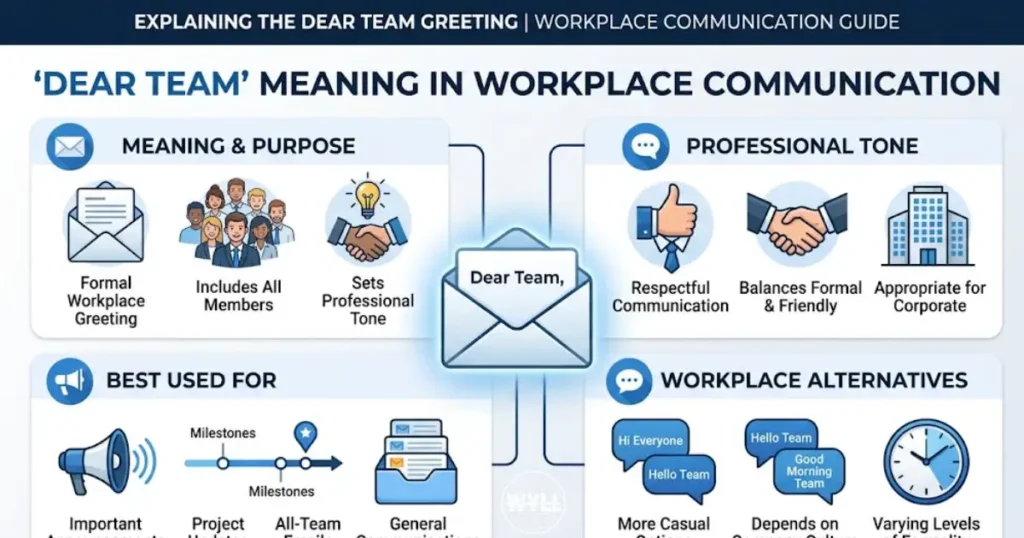
Table of Contents
What Does “Dear Team” Mean?
At its core, “Dear Team” is a group salutation that opens a message to multiple people without naming anyone individually. It borrows the traditional politeness of “Dear” and applies it to a collective rather than one recipient, which makes it efficient for workplace email and internal communication. The phrase carries a semantic blend of respect and neutrality, closer to formal address than a casual “Hey everyone.”
In practice, the meaning shifts slightly depending on context a manager’s announcement, a client update, or a quick office note all use “Dear Team” a little differently. Recognizing that flexibility is part of understanding true email salutation meaning, since the same three words can read as warm, businesslike, or purely procedural.
Simple Definition of “Dear Team”
In plain terms, “Dear Team” means “hello, everyone in this group,” phrased with the traditional courtesy of a letter opening. It is a professional, group-directed greeting used when the sender is addressing several people at once rather than a single named individual, and it works across email, memos, and internal announcements alike.
What “Dear Team” Actually Communicates
Beyond its literal meaning, “Dear Team” communicates inclusion and equal footing nobody in the group is singled out or left out. It signals that the message applies broadly, which reduces confusion. This subtle semantic function is one reason the phrase persists across so much corporate email and workplace correspondence.
Is “Dear Team” Formal or Casual?
“Dear Team” sits in the middle: more formal than “Hi Team” or “Hey folks,” but less stiff than “Dear Sir or Madam.” That balance is exactly why it works so well for everyday internal communication where you still want a professional tone without sounding distant or overly ceremonial to colleagues you know.
Example of “Dear Team” in a Message
“Dear Team, I wanted to share an update on next week’s schedule change before Friday’s meeting.” Here the greeting immediately establishes group relevance and a professional tone, letting the reader know the message applies to everyone and deserves attention.
Where Does the Phrase “Dear Team” Come From?
The word “Dear” has been used to open formal letters for centuries, originally signaling genuine affection before evolving into a standard courtesy marker. As business correspondence formalized, “Dear” attached itself to titles, names, and eventually collective nouns like “Team,” carrying forward politeness without requiring personal closeness between sender and reader.
This evolution reflects a broader entity relationship between letter-writing tradition and modern workplace email. As organizations grew and messages needed to reach whole departments, a scalable, respectful greeting became necessary and “Dear Team” filled that gap naturally within business communication norms.
Origin of the Phrase
“Dear” descends from formal English letter-writing convention, where it functioned as a standard courtesy rather than literal endearment. Attaching it to “Team” is a more modern adaptation, emerging as workplaces needed group-friendly greetings that still respected traditional business email etiquette.
How It Became Common in Workplace Communication
As companies scaled and teams expanded, addressing recipients individually became impractical. “Dear Team” offered a shortcut that preserved professional tone while covering an entire group, making it a natural fit for internal memos, announcements, and shared updates across departments.
The Influence of Email and Digital Communication
Email accelerated adoption because messages routinely go to distribution lists rather than one person. “Dear Team” translated well into this format, giving senders a fast, appropriate opener for group threads without needing to customize every message individually.
How to Use “Dear Team” in Emails and Messages
Using “Dear Team” well is mostly about matching it to context: a genuine group of colleagues, a shared update, or an announcement meant for everyone on a thread. It reads naturally when the content genuinely applies to the whole team, reinforcing clarity and professional tone from the very first line of the message.
It’s less about rigid rules and more about audience fit a phrase that works in a formal email may feel slightly stiff in a quick chat app message. Adjusting tone slightly by platform, while keeping the core greeting, keeps communication both professional and human.
Starting a Professional Email
“Dear Team” works well as an opening line when you’re sending a formal update, policy note, or scheduled announcement. It immediately signals that what follows is relevant to the whole group, setting a professional tone before the reader even reaches the first sentence.
Addressing a Large Group
For sizable groups where naming everyone isn’t practical, “Dear Team” is efficient and inclusive. It avoids the awkwardness of leaving names off a long list while still preserving a respectful, professional greeting appropriate for company-wide or department-wide messages.
Using “Dear Team” in Office Announcements
Announcements benefit from the formality “Dear Team” provides it signals importance and applies the message to everyone equally. This makes it a strong fit for policy changes, schedule updates, or leadership communications sent to an entire office or department.
Using It in WhatsApp or Team Chats
In chat apps, “Dear Team” can feel slightly formal, but it still works for serious updates or announcements. Many teams soften it slightly to “Hi Team” in casual chat threads while reserving “Dear Team” for more official or documented communication.
Real-Life Examples of “Dear Team”
Seeing “Dear Team” in real contexts makes its function clearer than any definition alone. Whether in a corporate inbox or a group chat, the phrase adapts its feel slightly based on platform and audience, while still preserving the same core purpose: addressing everyone at once respectfully.
These examples also show why the phrase persists across such different channels it’s flexible enough to work in formal corporate email and casual creator or freelance team chats alike, without losing its essential group-greeting function.
“Dear Team” in a Corporate Email
“Dear Team, please review the attached report before Thursday’s meeting.” This usage is classic and formal, fitting standard corporate email etiquette where the message applies to an entire department or project group.
“Dear Team” in a WhatsApp Office Group
“Dear Team, quick reminder that the office closes early tomorrow.” Even in a casual chat app, the greeting keeps a professional edge, useful when the sender wants the message taken seriously despite the informal platform.
“Dear Team” in an Instagram Work Collaboration
Creators and small brands sometimes open collaboration messages with “Dear Team” when addressing a partner’s full group rather than one contact, signaling respect and professionalism even within a social media messaging context.
“Dear Team” in a Creator or TikTok Team Chat
Freelance and creator teams use “Dear Team” for organized updates content calendars, deadline reminders, or brand guidelines borrowing corporate tone to keep informal creative workflows feeling structured and professional.
What Does “Dear Team” Say About Tone and Emotion?
Tone matters as much as wording, and “Dear Team” leans warm-professional rather than cold or purely transactional. It doesn’t carry deep personal affection, but it does signal courtesy, making the reader feel acknowledged as part of a group rather than an afterthought on a distribution list.
Emotionally, the phrase strikes a careful middle ground respectful enough for leadership communication, approachable enough for daily team updates. That balance explains why it remains a default choice across so many workplace and organizational contexts.
Is “Dear” a Sign of Affection?
In modern email, “Dear” rarely signals personal affection; it functions as a polite convention rather than genuine warmth. Its emotional weight has faded over time, becoming closer to a professional courtesy marker than an expression of closeness between sender and reader.
Does It Sound Respectful or Professional?
Yes “Dear Team” consistently reads as respectful and professional rather than cold. It acknowledges the group formally, which is precisely why it remains common in business email, announcements, and workplace correspondence across industries.
Does “Dear Team” Show Authority or Hierarchy?
The phrase can carry a mild sense of authority, especially from leadership, since formal group greetings often accompany top-down communication like policy updates or company-wide announcements rather than casual peer-to-peer messages.
Why People Choose This Greeting
People choose “Dear Team” because it’s safe, inclusive, and efficient it avoids naming errors, fits formal and semi-formal contexts, and consistently signals professionalism without requiring the sender to judge each recipient’s individual preference.
When Should You Use “Dear Team”?
“Dear Team” fits best when a message genuinely applies to a group and formality adds value rather than friction. Announcements, policy updates, and scheduled communications benefit from its professional tone, since the reader immediately understands the message is official and relevant to them.
It also solves a practical problem: when you don’t know every recipient personally, “Dear Team” lets you open respectfully without guessing names or titles, which keeps communication smooth even across departments you don’t interact with daily.
When Writing to a Large Work Group
Large groups benefit from a single, inclusive greeting rather than a long list of names. “Dear Team” covers everyone equally, keeping the message efficient while still preserving a professional, respectful tone throughout.
When Sending General Updates
Routine updates schedule changes, process notes, or shared resources read naturally under “Dear Team,” since the content applies broadly and doesn’t require a more personal or individually tailored greeting.
When Making a Professional Announcement
Formal announcements gain weight from “Dear Team,” which signals the message deserves attention. This is especially useful for leadership communication or anything meant to feel official rather than casual.
When You Do Not Know Everyone’s Name
If you’re new to a team or emailing across departments, “Dear Team” avoids the risk of misnaming someone while still sounding courteous, making it a safe default in unfamiliar professional situations.
When Should You Avoid “Dear Team”?
Despite its usefulness, “Dear Team” isn’t always the right choice. Personal or emotionally sensitive messages need a more individual tone, and using a group greeting in those moments can feel impersonal or even careless, undermining the message’s intent.
Small or very informal groups may also find it stiff. In these cases, a more specific or relaxed greeting better matches the relationship and communication style already established between sender and reader.
In Personal or Emotional Conversations
Sensitive topics feedback, condolences, or individual recognition need a personal greeting, not a group one. “Dear Team” can feel dismissive here, since it strips away the individual attention the moment requires.
When Writing to One Specific Person
If your message is meant for a single recipient, use their name instead. “Dear Team” in a one-on-one email reads as a mistake or template error, undercutting the message’s credibility and personal relevance.
In Very Small or Informal Groups
Tight-knit teams with established rapport often find “Dear Team” unnecessarily formal. A simpler “Hi all” or first names may match the relationship better without sacrificing professionalism.
When a More Specific Greeting Is Appropriate
If you’re addressing a distinct subgroup like “Marketing Team” or “Finance Department” naming that group specifically is clearer and more relevant than the generic “Dear Team.”
“Dear Team” vs. Other Professional Greetings
| Greeting | Tone | Best Use |
| Dear Team | Professional | Workplace groups |
| Hi Team | Friendly | Casual work communication |
| Hello Team | Neutral | General updates |
| Dear All | Formal | Larger groups |
| Dear Colleagues | Professional | Coworkers |
| Dear Staff | Formal | Staff-wide messages |
| Hello Everyone | Friendly | General audiences |
Which Greeting Fits Different Situations?
Formality should match the message: reserve “Dear Team” or “Dear Staff” for official communication, and save “Hi Team” or “Hello Everyone” for everyday updates. Matching tone to context keeps every group email feeling appropriate rather than mismatched.
Alternatives to “Dear Team”
Sometimes a different greeting fits the situation better than “Dear Team,” whether because the group is smaller, the tone needs to be warmer, or the audience expects more formality. Knowing a few reliable alternatives keeps your email salutation meaning flexible across different workplace scenarios.
Each alternative below carries a slightly different emotional weight, so choosing well comes down to matching the group, the platform, and the purpose of the message you’re sending.
Hi Team
A friendly, everyday alternative that suits casual internal updates and messages among colleagues who already know each other well, without losing basic professionalism.
Hello Team
Slightly more neutral than “Hi Team,” this option works for general updates that don’t require heavy formality but still deserve a polished tone.
Dear All
A common formal alternative for larger or mixed-audience groups, often used interchangeably with “Dear Team” in company-wide emails and announcements.
Dear Colleagues
Best suited for peer-level professional communication, this greeting emphasizes shared status rather than a formal team structure, fitting cross-department messages well.
Hello Everyone
A warm, inclusive greeting ideal for broader audiences, community updates, or messages where a slightly softer tone than “Dear Team” feels more appropriate.
Team,
A minimalist option often used in fast-paced or startup environments, dropping the greeting word entirely while still directing the message clearly to the group.
Greetings Team
A slightly more distinctive formal option, useful when a sender wants to stand out from the standard “Dear Team” while keeping a professional register.
Dear Members
Common in clubs, associations, or membership-based organizations, this alternative fits contexts where “Team” doesn’t accurately describe the group’s structure.
Conclusion
“Dear Team” earns its place in everyday work email because it solves a real problem: how to greet a group respectfully without singling anyone out or sounding careless. Its meaning has shifted over time from personal warmth to professional courtesy, but that shift is exactly what makes it so dependable today.
Choosing the right greeting still comes down to reading the room the size of the group, the formality of the message, and the relationship you share with the people receiving it. Once you understand the dear team meaning behind those two words, picking the right opener for any workplace message becomes second nature rather than guesswork.
FAQs
Author

Ethan Carter is a search engine optimization blogger focusing on web slang, text content abbreviations, and social media implications. He creates clean, accurate, and reader-friendly content backed by using thorough research. Its purpose is to help readers understand modern online language with reliable, flexible publications.