

OBO Meaning in Business: What “Or Best Offer” Really Means
Seeing “$450 OBO” on a marketplace listing can leave you wondering what the seller actually means. Is $450 the final price, or can you offer less? In most cases, OBO means “or best offer,” which tells potential buyers that the listed price is open to negotiation.
OBO is commonly used in online marketplaces, classified ads, private sales, text messages, and small-business transactions. Understanding the term can help buyers make reasonable offers and help sellers attract more potential customers.
In this guide, you’ll learn what OBO means, how it works, where it is used, and how both buyers and sellers can handle OBO negotiations effectively.
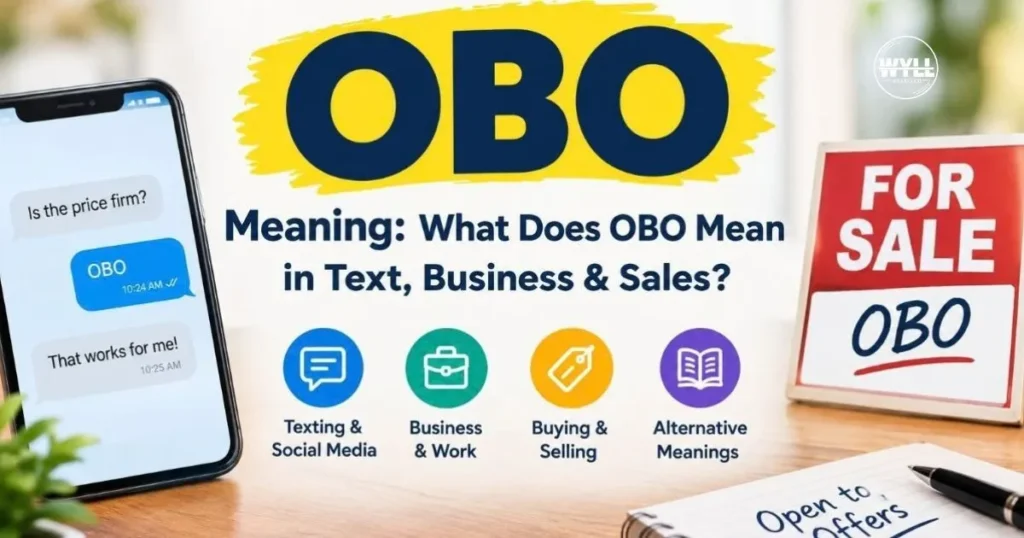
Table of Contents
What Does OBO Mean?
OBO stands for “or best offer.” It is usually placed after a selling price to show that the seller is willing to consider other offers.
For example:
$500 OBO
This generally means the seller is asking $500 but may accept a reasonable offer below that amount.
OBO does not mean that the seller must accept the lowest offer. Instead, it indicates that the listed price is a starting point for negotiation.
Why Do Sellers Use OBO?
Sellers often add OBO when they want to:
- Attract more potential buyers
- Encourage people to make offers
- Sell an item faster
- Test what buyers are willing to pay
- Leave room for negotiation
It can be especially useful when the seller isn’t sure how much buyers are willing to pay for an item.
What Does OBO Mean in Text Messages?
In text messages, OBO usually has the same meaning: “or best offer.”
It often appears when someone is selling something to friends, family members, or people in a group chat.
For example:
“Selling my bike for $150 OBO.”
The person is asking for $150 but is open to considering reasonable offers.
Because text messages provide less context than a marketplace listing, OBO usually appears alongside an item and a price. A message containing only “OBO” may be unclear without additional information.
OBO Meaning in Business and Small Businesses
OBO can also be useful for small businesses, particularly when selling used equipment, excess inventory, returned products, furniture, or other items.
For example, a small business might list an old office desk for:
$200 OBO
This tells potential buyers that the business is willing to consider offers rather than requiring everyone to pay exactly $200.
OBO can also help businesses learn more about market demand. If several buyers make offers, the seller can compare them and get a better idea of what customers consider a reasonable price.
What Does “Or Best Offer” Mean?
“Or best offer” means that the seller is willing to consider offers instead of requiring the exact listed price.
Suppose an item is listed for:
$1,000 OBO
A buyer might offer $850. The seller could:
- Accept $850
- Counter with $925
- Reject the offer
- Wait for another buyer
- Accept a different offer
The important point is that OBO does not guarantee a discount. It simply signals that negotiation is possible.
How Is OBO Used in Online Listings?
Online sellers commonly place OBO directly after the asking price.
Examples include:
- $100 OBO
- $750 OBO
- $2,500 OBO
This format quickly tells buyers that the price isn’t necessarily final.
OBO is common on marketplace platforms, classified websites, community groups, and other places where individuals sell products directly to other people.
OBO Meaning on Facebook Marketplace and Classified Ads
On Facebook Marketplace and similar classified platforms, OBO generally means “or best offer.”
For example, someone might list a used phone for:
$300 OBO
A buyer could message:
“Would you take $250?”
The seller could then accept the offer or respond with a counteroffer such as $275.
The exact process depends on the platform and the seller, but the basic idea remains the same: the listed price is open to negotiation.
How OBO Works When Buying or Selling Something
OBO creates a simple negotiation process between a buyer and seller.
Step 1: Seller Sets an Asking Price
The seller chooses a starting price based on the item’s condition, market value, and desired selling price.
Step 2: Seller Adds OBO
Adding OBO tells buyers that the seller is willing to consider other offers.
Step 3: Buyer Makes an Offer
The buyer researches the item and submits a specific amount they are willing to pay.
Step 4: Seller Reviews the Offer
The seller can accept, reject, or counter the offer.
Step 5: Both Sides Reach an Agreement
If both parties agree on the price and terms, they can complete the transaction.
What Does OBO Mean When Selling Something?
For sellers, OBO means that the advertised price is not necessarily fixed.
For example:
Laptop — $600 OBO
The seller wants $600 but may consider a reasonable offer.
However, sellers should avoid setting an unrealistic asking price just because they plan to negotiate. A reasonable starting price gives buyers a useful reference point and can lead to more serious offers.
Examples of OBO in Real Conversations
Here are some simple examples:
Example 1:
“Selling my bike for $150 OBO.”
A buyer may offer $120.
Example 2:
“Old gaming console, $200 OBO.”
A buyer might offer $175, and the seller could counter at $190.
Example 3:
“Desk available for $100 OBO. Pickup this weekend.”
A buyer may offer $80 if they can pick it up quickly.
These examples show that OBO creates an opening for negotiation without requiring the seller to accept every offer.
Examples of OBO in Business and Sales
Businesses can use OBO when selling items where the final value may depend on buyer interest.
For example, a business could advertise:
Used office furniture $1,000 OBO
Several buyers might respond with different offers. The seller can then consider not only the price but also other factors such as pickup timing and transaction convenience.
OBO can therefore be useful when a business wants to sell something while remaining flexible about the final price.
How to Make an Offer on an OBO Listing
If you’re buying an item marked OBO, make your offer clear and reasonable.
1. Research the Market Price
Look at similar listings to understand what comparable items are selling for.
2. Consider the Item’s Condition
An item’s age, condition, features, and included accessories can affect its value.
3. Make a Specific Offer
Instead of asking:
“What’s your lowest price?”
try making a clear offer:
“Would you consider $275?”
4. Explain Relevant Conditions
If you can pick up the item immediately or have another useful condition, mention it politely.
5. Be Respectful
A reasonable offer is more likely to receive a useful response than an extremely low offer.
How to Get the Best Deal From an OBO Listing
Buyers can improve their negotiating position by understanding the listing and the seller’s situation.
Check how long the item has been listed and compare it with similar products. A listing that has been available for a long time may have more room for negotiation, although this is not guaranteed.
You can also offer convenience. For example, being flexible about pickup time may make your offer more attractive even if it isn’t the highest possible price.
How Sellers Use OBO to Attract Buyers
Sellers use OBO because it can encourage people who might ignore a fixed-price listing to make an offer.
It can also provide useful information about demand. If multiple buyers respond with similar offers, the seller gains a better understanding of how the market views the item’s price.
However, sellers should be prepared to receive offers below their asking price. Setting a realistic starting price can help keep negotiations productive.
Pros and Cons of Using OBO
| Pros | Cons |
| Can attract more buyers | May attract very low offers |
| Allows price flexibility | Requires time to negotiate |
| Can help sell items faster | Final price isn’t guaranteed |
| Provides information about buyer demand | Some buyers may negotiate aggressively |
OBO can be useful when flexibility matters, but it may not be suitable for sellers who want a strict, non-negotiable price.
OBO vs. Firm Price: What Is the Difference?
The main difference is whether negotiation is expected.
A firm price means the seller generally does not want to negotiate.
An OBO price signals that the seller is willing to consider other offers.
For example:
$500 Firm4
The seller is asking for $500 without negotiation.
$500 OBO
The seller is asking for $500 but is open to considering offers.
Choosing between the two depends on how much flexibility the seller wants during the sale.
OBO vs. Negotiable Price: Are They the Same?
OBO and “negotiable” are closely related because both indicate that the listed price may not be final.
However, OBO is a commonly used shorthand that directly means “or best offer.” The term “negotiable” is broader and simply tells buyers that the price may be discussed.
In practical marketplace conversations, both terms can invite buyers to make a different offer.
Other Meanings of OBO You Should Know
Although “or best offer” is common in selling and marketplace contexts, OBO can have other meanings.
One example is “on behalf of,” which can appear in business communication or formal correspondence.
For example:
“Signed OBO the company director.”
The surrounding context is important. If OBO appears next to a price, “or best offer” is usually the intended meaning. If it appears in a formal business message, another meaning may apply.
Is OBO Rude, Flirty, or Offensive in Texting?
OBO is generally a neutral abbreviation when it is used in a buying or selling context.
It is not inherently rude, flirty, or offensive. In most marketplace conversations, it simply communicates that the seller is open to offers.
If someone sees OBO without the surrounding context, the meaning may be unclear. Looking at the message, price, and situation can help determine what the abbreviation means.
How to Respond When Someone Says OBO
If you’re a buyer, respond with a specific offer rather than only asking for the seller’s lowest price.
For example:
“Would you accept $120? I can pick it up today.”
This gives the seller a clear proposal.
If you’re the seller, you can accept the offer, reject it, or make a counteroffer.
For example:
“Thanks for the offer. I could do $135.”
Keeping the conversation clear and respectful makes negotiation easier for both sides.
Common Mistakes When Using OBO
Setting the Asking Price Too High
An unrealistic price can attract offers that are much lower than expected.
Making Extremely Low Offers
Buyers who offer far below a reasonable market price may not receive a serious response.
Being Vague
Messages such as “lowest?” don’t tell the seller what you’re actually willing to pay.
Ignoring the Item’s Condition
Buyers should consider condition and comparable listings before making an offer.
Not Defining Important Terms
For larger transactions, buyers and sellers should clarify payment, pickup, delivery, timing, and other relevant details before agreeing.
FAQs
Author

Ethan Carter is a search engine optimization blogger focusing on web slang, text content abbreviations, and social media implications. He creates clean, accurate, and reader-friendly content backed by using thorough research. Its purpose is to help readers understand modern online language with reliable, flexible publications.