Moon Tattoo Meaning: Symbolism, Phases & Design Ideas
Moon tattoo meaning usually centers on cycles, intuition, mystery, and change, but the chosen phase can make the message much more personal. After reviewing current tattoo guides and community discussions, I’ve found readers commonly want clarity on symbolism, crescent moon meaning, full moon meaning, moon phases, and whether the design carries one fixed message.
It doesn’t. Lunar phases, emotional growth, dreams, subconscious themes, cultural context, and personal memory can all shape interpretation. NASA explains that the Moon moves through eight phases in a repeating cycle, while museums document very different lunar stories across cultures. This guide connects those facts with practical tattoo symbolism so readers can understand the design without relying on one rigid definition.
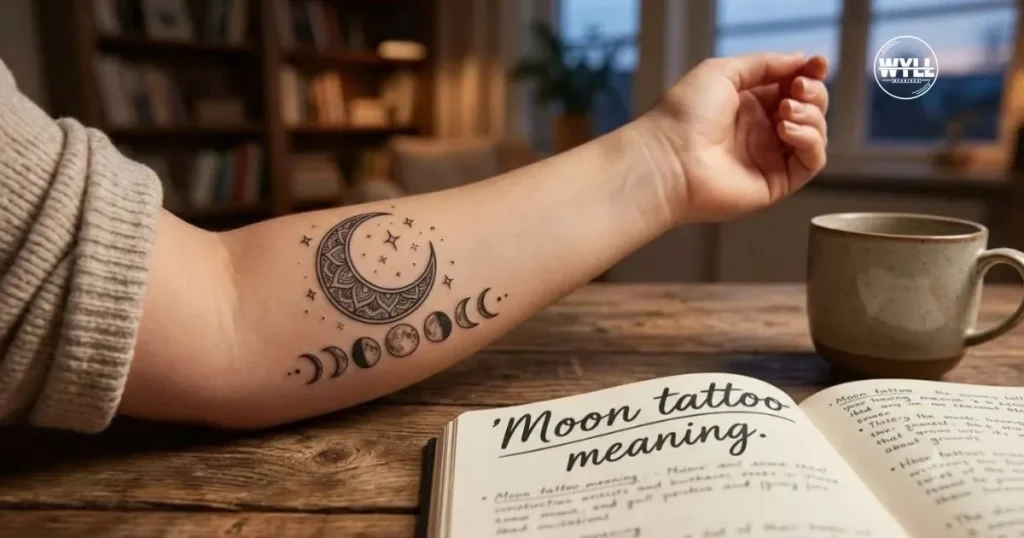
Table of Contents
Moon Tattoo Meaning: What Does a Moon Tattoo Symbolize?
Moon tattoo meaning is commonly connected with mystery, intuition, change, cycles, and the hidden side of life. The symbol works because the Moon visibly changes while remaining familiar, giving it a natural link with growth, renewal, time, emotional reflection, and the feeling that difficult seasons can pass.
The personal meaning matters just as much as traditional symbolism. One person may see a crescent as hope after a hard chapter; another may use a moon as a memorial, family symbol, or reminder of a meaningful night. Community conversations show that tattoo stories are often individual rather than universal.
Moon Tattoo Meaning: The Core Meanings
Moon tattoo meaning often begins with a few recurring ideas: mystery, feminine symbolism, cycles, intuition, and guidance. These themes appear repeatedly across current tattoo guides, although none should be treated as a universal definition. The design, cultural reference, personal history, and surrounding symbols can all change the emotional message.
The Moon has also inspired meanings beyond tattoos because people have used it for timekeeping, art, ritual, agriculture, navigation, and storytelling. Museums describe it as a powerful cultural symbol whose interpretation changes between communities. That context helps explain why one simple crescent can carry very different stories for different people.
Mystery and the Unknown
Mystery and the Unknown remain central because the Moon has long represented what happens beyond ordinary daylight. In tattoo symbolism, that can suggest curiosity, hidden feelings, dreams, uncertainty, or comfort with unanswered questions. A darker, minimalist design may emphasize that mysterious quality without needing elaborate imagery.
Femininity and the Divine Feminine
Femininity and the Divine Feminine appear in some traditions, but they are cultural associations rather than universal rules. The lunar cycle has often been connected with fertility, womanhood, and feminine symbolism in art and ritual. A moon tattoo can reflect those ideas while still carrying a completely personal interpretation.
Change and Cycles
Change and Cycles are especially intuitive meanings because the Moon repeatedly shifts through phases. A tattoo can mark personal growth, recovery, transition, or the acceptance that life is not linear. The symbolism becomes strongest when the chosen phase reflects the chapter the wearer wants to remember.
Intuition and the Subconscious
Intuition and the Subconscious connect the Moon with dreams, emotion, reflection, and inner awareness. In tattoo language, this can mean trusting your instincts or acknowledging feelings that are not always visible. The association is symbolic, not a scientific claim about the Moon controlling human behavior.
Guidance in the Dark
Guidance in the Dark gives the moon tattoo a quieter, hopeful meaning. Moonlight can symbolize direction when the path feels uncertain, while a visible crescent or full moon can become a private reminder to keep moving. For someone marking a difficult transition, that message can feel more personal than decorative.
Moon Tattoo Meaning: Moon Phase Tattoo Meanings: New, Crescent, Full & Waning
Moon tattoo meaning changes noticeably with the phase you choose. NASA identifies eight astronomical phases, from new Moon through waxing and waning stages. Tattoo culture simplifies those stages into familiar symbolic ideas such as beginnings, growth, balance, completion, release, and renewal, making phase choice an important part of the story.
The symbolism is interpretive rather than scientifically fixed. A crescent may suggest new beginnings, a full moon completion, and a waning moon release, but your reason for choosing the image can outweigh a traditional association. The important distinction is between astronomical facts and the personal meanings people attach to them.
| Moon phase/design | Common symbolic interpretation |
| New moon | Fresh start, potential, reset |
| Crescent moon | Growth, beginnings, hope, transition |
| Half/quarter moon | Balance, decision, midpoint |
| Full moon | Completion, clarity, fullness |
| Waning moon | Release, closure, letting go |
| Full phase sequence | Cycles, transformation, renewal |
NASA describes eight phases rather than only the simplified tattoo categories above, so the table is a symbolic interpretation rather than an astronomy chart.
Moon Tattoo Meaning: Cultural and Mythological Moon Meanings
Cultural and mythological moon meanings are unusually rich because societies have used the Moon for calendars, stories, art, ritual, and navigation. Greek traditions connect lunar imagery with Selene and Artemis; Roman tradition names Luna; ancient Egyptian art includes Khonsu; Chinese tradition includes Chang’e.
These traditions should not be treated as one universal “moon meaning.” Museum sources describe the Moon as a cultural mirror, with different communities associating it with longing, contemplation, fertility, time, guidance, or seasonal cycles. Using a cultural reference thoughtfully can add depth, but it is worth naming the tradition accurately.
Moon Tattoo Meaning: Spiritual or Religious Meaning
Moon tattoo meaning can also be spiritual or religious, depending on the tradition and the wearer’s beliefs. Current tattoo guides mention divine feminine symbolism, Hindu references to Chandra, and Buddhist interpretations of moon imagery. These should be presented as tradition-specific associations, not as a single spiritual definition shared by everyone.
The strongest spiritual designs usually have a clear reason behind the symbolism. A moon can represent reflection, renewal, devotion, enlightenment, or connection with nature, but those meanings come from the wearer’s story and cultural framework. This makes a meaningful design more precise than simply labeling every moon tattoo mystical.
Moon Tattoo Meaning: Meaning of Different Moon Designs
Meaning of different moon designs often comes from shape and composition. A full moon can emphasize completion; a crescent can suggest beginnings or transition; a half moon can suggest balance; and a full phase sequence can communicate an entire cycle. Companion imagery can then narrow the message further.
Color usually changes mood more than core symbolism. Black and gray can make the design feel classic or restrained, while blue, purple, or warm tones may create a dreamier visual effect. Stars, flowers, moths, wolves, mountains, or a sun can add associations such as nature, transformation, instinct, or balance.
Moon Tattoo Meaning: Popular Moon Tattoo Styles
Popular moon tattoo styles include fine-line minimalist work, geometric or mandala designs, blackwork, watercolor, and realism. The same crescent can feel delicate in fine line or dramatic in blackwork, while a detailed full moon gives realism more room to show texture, craters, and shadow.
Style should support the meaning rather than compete with it. A subtle moon may suit someone who wants a private reminder, while a larger illustrated scene can turn the lunar symbol into a broader story. Current tattoo guides also emphasize that scale, contrast, spacing, and placement affect long-term readability.
Moon Tattoo Meaning: Where Do Moon Tattoos Look Best?
Where do moon tattoos look best? That depends on the design, size, visibility, and personal significance. Current guides commonly discuss the wrist, forearm, ribs, ankle, shoulder, back, and spine. A small crescent needs less room, while a detailed full moon or phase sequence benefits from a larger surface.
Placement does not automatically change the core symbolism, but it can change how the tattoo feels in daily life. A visible wrist piece can act as a frequent reminder, while a shoulder or back design may feel more private. The practical choice is therefore about composition, visibility, and personal meaning.
Moon Tattoo Meaning: What Does A Moon Tattoo Mean for Men and Women?
What does a moon tattoo mean for men and women? There is no single gender-specific definition. Historical associations with feminine symbolism exist, but moon tattoos can also represent strength, wisdom, loyalty, protection, family, independence, or personal growth for anyone who connects with the imagery.
This is why calling a moon tattoo inherently feminine can be misleading. Cultural associations change across time and place, and modern wearers often choose the symbol for astronomy, nature, memory, or a personal milestone. Community discussions similarly show that the story behind a tattoo can matter more than a preset label.
Conclusion
Moon tattoo meaning is best understood as a starting point, not a fixed dictionary entry. The strongest recurring themes are cycles, intuition, mystery, change, growth, guidance, and renewal, while the exact message can shift with the phase, style, color, companion symbols, culture, and personal story attached to the design.
Before settling on an interpretation, ask what you want the moon to remember for you. A crescent might mark a beginning, a full moon a milestone, and a phase sequence an entire chapter of change. When the symbolism and your reason align, the tattoo becomes more than a familiar night-sky image.
FAQs
Author

Ethan Carter is a search engine optimization blogger focusing on web slang, text content abbreviations, and social media implications. He creates clean, accurate, and reader-friendly content backed by using thorough research. Its purpose is to help readers understand modern online language with reliable, flexible publications.