Define Overpowered Meaning: Definition, Slang & Examples
Define overpowered meaning in simple English, and it means having more power or strength than is necessary, expected, or reasonably balanced. In gaming, the word usually describes a character, weapon, ability, build, or strategy that feels unusually strong. You may also see related terms such as OP, powerful, strong, unbalanced, dominant, and underpowered in online conversations.
The confusion usually starts when “overpowered” appears in gaming chats, Reddit posts, Discord messages, or social media comments. In my experience explaining internet vocabulary, context makes the biggest difference. This guide breaks down the overpowered definition, OP slang, gaming meaning, examples, synonyms, opposites, and common uses so you can understand exactly what someone means without guessing.
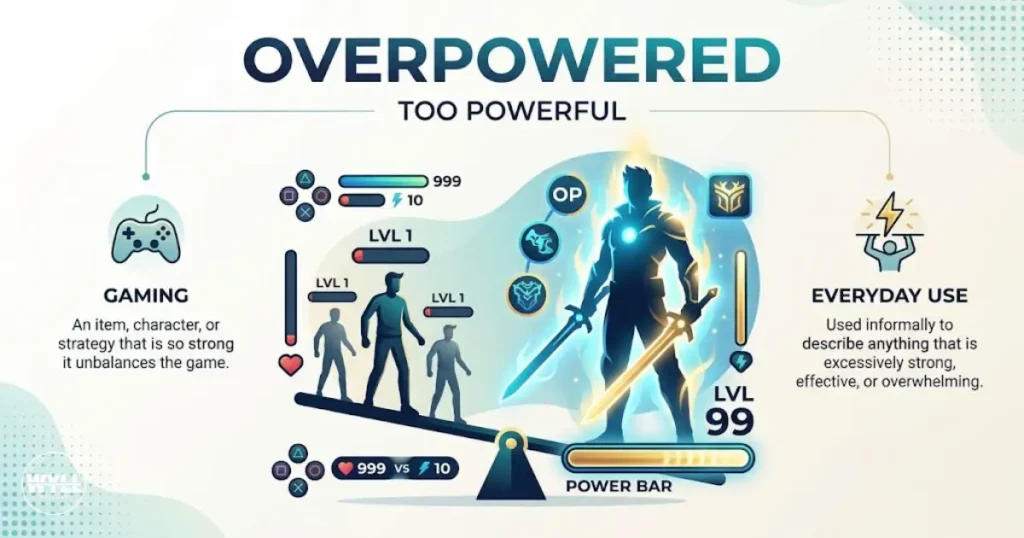
Table of Contents
Define Overpowered Meaning: What Does OP Mean in Gaming?
To define overpowered meaning in gaming, think of something that is much stronger or more effective than similar options. Players may call a character “OP” when it deals excessive damage, survives too easily, has very few weaknesses, or provides an unusually large advantage during a match.
The term is closely connected with game balance, competitive gaming, character abilities, weapons, builds, strategies, counters, patches, buffs, and nerfs. However, calling something OP is often a player’s opinion rather than an official statement from a game developer. A powerful feature can still be considered balanced when it has meaningful weaknesses.
Simple Example of OP in Gaming
Imagine a game introduces a new character with extremely high damage, excellent defense, fast movement, and an ability that other players struggle to counter. Players may say, “That character is OP.” Here, OP means overpowered, suggesting that the character is stronger than the surrounding choices.
Another player might simply say the character is “strong.” That wording does not necessarily suggest a balance problem. The difference is important: strong can be a compliment, while overpowered often suggests excessive effectiveness compared with other choices.
Define Overpowered Meaning: What Does OP Stand For?
When you define overpowered meaning through gaming slang, OP is the common abbreviation for overpowered. It is short, fast to type, and widely understood in gaming communities. You may see it in game chats, forums, comments, livestreams, Discord servers, and social media discussions about competitive gameplay.
For example, a player might write, “This weapon is OP,” meaning the weapon seems too powerful. Another might say, “That build is completely OP.” The abbreviation saves time while communicating the same basic idea. However, OP does not always mean overpowered, because the abbreviation can have different meanings in other online contexts.
OP Does Not Always Mean Overpowered
Outside gaming, OP often means original poster, referring to the person who created a discussion or thread. It can also refer to the original post itself. Because of this, the surrounding words are important when interpreting OP on Reddit, forums, Facebook, Discord, or other social platforms.
A sentence such as “OP replied to my comment” usually refers to the original poster. On the other hand, “That weapon is OP” is normally about something being overpowered. Learning the context is the easiest way to avoid misunderstanding this popular internet abbreviation.
Define Overpowered Meaning: Why Do Gamers Say OP?
One reason gamers use OP is convenience. Writing two letters is faster than typing “overpowered,” especially during a fast multiplayer match or an active online discussion. Gaming communities regularly use short terms such as OP, GG, AFK, DPS, buff, nerf, and meta to communicate ideas quickly.
There is also an emotional side to the phrase. Calling something OP may express excitement, frustration, surprise, admiration, or criticism. Someone may say “That combo is OP!” because they are impressed by its strength, while another player may use the same phrase because they believe the game is poorly balanced.
OP Can Be Positive or Negative
The meaning of OP is not automatically negative. In casual gaming conversations, people sometimes use it almost as praise, especially when talking about an impressive character, clever strategy, or extremely effective combination. The tone of the conversation often tells you whether the speaker is celebrating or criticizing the power level.
For example, “That move is OP!” could mean “That move is incredibly effective.” But “This update made the character OP” may suggest that the player thinks the new balance is unhealthy. The same word can therefore carry different feelings without changing its core meaning.
Define Overpowered Meaning vs. Strong: What’s the Difference?
To define overpowered meaning correctly, it helps to compare it with the word strong. Something can be strong without being overpowered. A strong character might have excellent abilities but still have weaknesses, limitations, counters, or trade-offs that keep the overall experience balanced.
Overpowered usually goes one step further. It suggests that the amount of strength is excessive compared with what is needed or compared with competing choices. This distinction appears not only in games but also when people describe computers, equipment, engines, skills, or other powerful things in everyday English.
| Term | Meaning | Common context |
| Overpowered | Excessively powerful or effective | Gaming, technology, general English |
| Strong | Having considerable power or ability | Everyday English, gaming |
| Powerful | Capable of producing a strong effect | General English |
| Underpowered | Not powerful enough for the task | Gaming, machines, technology |
| Balanced | Reasonably matched in power and limitations | Gaming |
Define Overpowered Meaning: Origin and Background
The word overpowered comes from the verb overpower, which combines “over” with “power.” In ordinary English, overpower can describe defeating or controlling someone through greater strength or force. The adjective overpowered can also describe something that has more power than necessary.
Modern gaming added a more specialized use of the word. Players began using overpowered to describe game elements that seemed excessively strong compared with alternatives. Over time, OP became common shorthand for this idea, particularly in online gaming communities and discussions about game balance.
Gaming Slang and Online Culture
Gaming slang develops naturally because players communicate quickly and repeatedly about the same concepts. Words such as OP, nerf, buff, meta, broken, and counter became familiar parts of this language. These terms help players describe power, balance, changes, and competitive strategies without needing long explanations.
The exact historical first use of OP for “overpowered” is difficult to establish. Rather than attaching the expression to a single game or person, it is more accurate to understand it as part of the broader development of online gaming and internet communication.
Define Overpowered Meaning in Different Gaming Contexts
To fully define overpowered meaning, consider what type of game element is being discussed. Players may call a character OP because of excessive damage, an ability OP because it has too few counters, or a weapon OP because it performs much better than comparable equipment.
The expression can also describe builds, strategies, classes, teams, combinations, items, mechanics, or even temporary game mechanics. In a casual game, OP may simply mean “very powerful.” In a competitive game, the same word can lead to discussions about fairness, balance updates, and the current meta.
OP in Competitive Games
In competitive games, balance is especially important because players are usually looking for fair opportunities to succeed. When one character, weapon, or strategy becomes disproportionately effective, the community may describe it as OP. This can lead to requests for a nerf, meaning developers reduce its effectiveness.
OP in Casual Games
In casual games, the word OP can be less serious. A player may call a funny combination or powerful item OP simply because it makes the game easier or more entertaining. In this setting, the term often has a playful tone rather than being a formal complaint about competitive fairness.
Define Overpowered Meaning: When Should You Avoid OP?
The best way to define overpowered meaning is not only understanding what it means but also knowing where the abbreviation belongs. OP works naturally in informal conversations, online communities, gaming chats, comments, and social media. It may sound too casual in a school essay, professional report, business message, or formal explanation.
In formal writing, spelling out overpowered is usually clearer. You can also use alternatives such as excessively powerful, unusually strong, disproportionately effective, difficult to counter, or poorly balanced, depending on the situation. Clear wording matters more than slang when your audience may not understand online abbreviations.
Formal vs. Informal Usage
Consider the difference between these two sentences: “That character is OP” and “The character appears disproportionately powerful compared with the available alternatives.” The first sounds natural in a gaming chat; the second is more appropriate for an analytical article or professional discussion about game design.
Define Overpowered Meaning: Common Misunderstandings
A major misunderstanding is believing that overpowered always means something is officially broken. Usually, it does not. Players use the term to describe what they believe is excessive power. Developers may later make changes, but a player’s use of OP is not automatically an official balance ruling.
Another misconception is that overpowered always means “bad.” That is also not true. Someone can admire something for being extremely powerful and still call it OP. The word mainly communicates degree and comparison. Whether that level of power is good, bad, fun, or unfair depends on the context and the speaker.
Is OP the Same as Broken?
Not necessarily. Broken is often used for something that is extremely unbalanced or behaves in a way that creates serious problems. OP generally means excessively powerful. A game element can be very strong without literally being broken, and players may disagree about where that line exists.
Define Overpowered Meaning vs. Similar Gaming Slang
Understanding related gaming terms makes it easier to define overpowered meaning accurately. A buff generally makes a character, weapon, or ability stronger. A nerf reduces its effectiveness. Meta refers to the strategies, characters, or choices currently considered highly effective within a particular competitive environment.
These terms often appear in the same conversation. For example, players might say that a character became OP after receiving a buff, leading developers to release a nerf. Another player may argue that the character is not OP but simply part of the current meta. The terms overlap, but they are not identical.
| Gaming slang | Basic meaning |
| OP | Overpowered |
| Nerf | Reduce power or effectiveness |
| Buff | Increase power or effectiveness |
| Meta | Current effective competitive approach |
| Broken | Extremely unbalanced or malfunctioning |
| Underpowered | Weaker than expected or needed |
| Counter | A choice or strategy effective against another |
Define Overpowered Meaning on Social Media and Chat Apps
When you define overpowered meaning on social media, context becomes even more important. Gaming communities on Reddit, Facebook, Discord, TikTok, and other platforms commonly use OP to mean overpowered when discussing characters, weapons, abilities, or strategies.
However, the same platforms also use OP for original poster. A message such as “OP shared the screenshot” likely refers to the person who started the post. In gaming comments, “This sword is OP” almost certainly refers to excessive power. Look at the words surrounding OP before deciding which meaning applies.
How to Tell Which Meaning Is Intended
A simple context check usually works. Words such as weapon, character, damage, ability, game, build, nerf, buff, balance, and attack strongly suggest “overpowered.” Words such as thread, post, comment, replied, uploaded, and community often suggest “original poster” or “original post.”
Define Overpowered Meaning: Examples in Everyday English
The word is not limited to games. Someone might describe a computer as overpowered when its performance is far beyond what a basic task requires. A person might also say a machine is overpowered for a simple job when it has much more capacity than necessary.
There is another English use connected with the verb overpower. In that sense, someone or something can be overpowered by greater force or influence. This is different from the modern gaming slang sense, which is why the sentence around the word matters so much.
Example Sentences
Gaming: “Players believe the new character is overpowered.”
Technology: “That computer is overpowered for basic web browsing.”
General English: “The smaller team was overpowered by a much stronger force.”
Social media: “OP said the original post was updated.”
These examples show why context determines meaning, especially when the abbreviation OP is used.
Conclusion:
The simplest way to define overpowered meaning is to think of something as having more power or effectiveness than is necessary, expected, or reasonably balanced. In gaming, OP commonly describes a character, weapon, ability, build, or strategy that seems unusually strong compared with available alternatives. The term can be positive praise, criticism, or casual slang depending on the conversation.
The biggest lesson is context. OP can mean overpowered in gaming, but it can also mean original poster or original post online. Once you understand the surrounding words, the intended meaning becomes much easier to recognize. Whether you found the term in a game, Reddit thread, Discord chat, or social media comment, you now have a clear framework for understanding what overpowered really means.
FAQs
Author

Ethan Carter is a search engine optimization blogger focusing on web slang, text content abbreviations, and social media implications. He creates clean, accurate, and reader-friendly content backed by using thorough research. Its purpose is to help readers understand modern online language with reliable, flexible publications.