FAQs Meaning: What Does FAQ Stand For, Uses & Examples
FAQ simply means “Frequently Asked Questions.” An FAQ is a collection of common questions and their answers about a website, product, service, organization, or topic. Cambridge defines FAQ as an abbreviation used for frequently asked question or questions, particularly in internet and business contexts.
When you browse American websites, online stores, apps, software pages, schools, or customer-support portals, you will often see FAQ or FAQs. In practical content work, understanding this small abbreviation helps you quickly recognize common questions, prepared answers, help resources, customer service information, and digital support content without searching through an entire website.
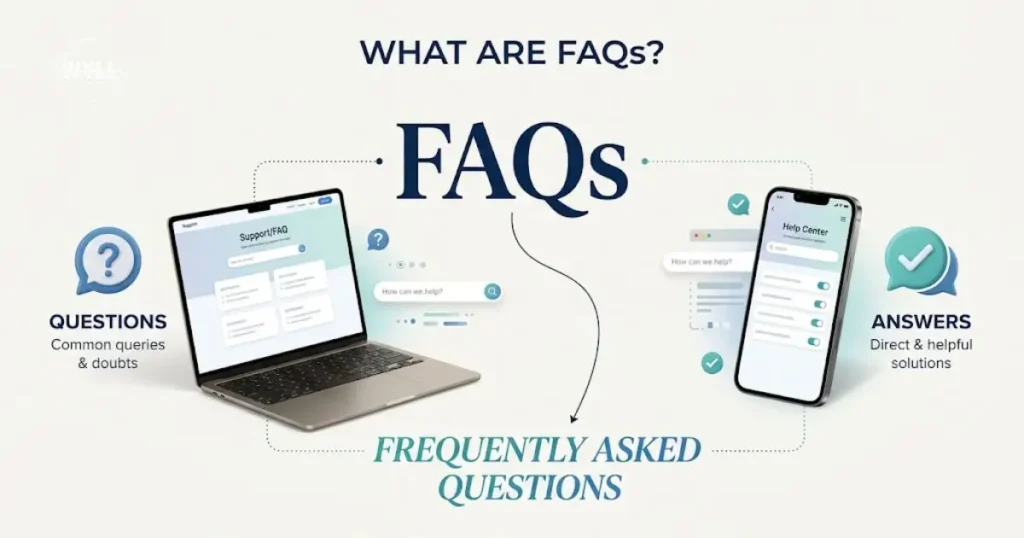
Table of Contents
FAQs Meaning: What Does FAQ Stand For?
FAQs meaning is simple: FAQ stands for “Frequently Asked Questions.” It describes a group of common questions and answers about a topic, product, service, website, or organization. Cambridge defines FAQ as an abbreviation for frequently asked question or questions, especially in internet and business contexts.
The phrase matters because people often encounter FAQ on American websites, apps, stores, schools, software pages, and customer-service portals without knowing the full form. Once you recognize the term, an FAQ becomes easy to understand: it is a convenient place to find answers before contacting someone.
FAQs Meaning: What Is an FAQ?
An FAQ is a prepared collection of recurring questions with useful answers. The questions usually reflect what visitors, customers, students, readers, or users commonly want to know. Instead of scattering information across several pages, the FAQ brings practical answers together in one easy-to-find resource.
For example, an online store might answer questions about shipping, payment methods, returns, refunds, and order tracking. A university may cover admissions, deadlines, tuition, and registration. In both cases, FAQs reduce the effort required to find basic information and give users a faster path to clarity.
FAQs Meaning: Why Do Websites Have FAQ Pages?
Websites use FAQ pages because repeated questions consume time for both visitors and support teams. A clear FAQ can answer predictable concerns about pricing, delivery, accounts, policies, or features without requiring a phone call or email. That makes information easier to access when users need it.
A helpful FAQ can also support a smoother customer journey. Someone comparing products may want one specific answer before purchasing, while a new user may need a simple setup explanation. Good FAQ content removes small points of friction without replacing detailed documentation or direct support when needed.
FAQs Meaning in Simple Words
In everyday language, FAQs meaning can be explained as “common questions with ready answers.” Think of it as a shortcut for information. Instead of asking the same thing repeatedly, a website writes the answer once and lets many people read it whenever the question comes up.
A simple example is a password page that asks, “How do I reset my password?” and gives the exact steps underneath. That question-and-answer pair is an FAQ entry. The format is straightforward, practical, and especially useful when the same information is needed by many users.
FAQs Meaning: What Does FAQs Mean?
FAQs is commonly used as the plural form when referring to multiple frequently asked questions or multiple FAQ entries. In everyday English, both “FAQ” and “FAQs” are widely understood. A page can be called an FAQ, while a collection of individual questions may naturally be called FAQs.
This small spelling difference causes confusion because the original phrase already includes plural “questions.” Modern usage still commonly adds the letter s to FAQ when talking about several entries or more than one FAQ resource. There is no apostrophe in the standard plural form: FAQs.
FAQs Meaning: FAQ vs. Q&A What’s the Difference?
FAQ and Q&A both involve questions and answers, but their usual roles differ. An FAQ is built around questions that recur, while Q&A is a broader format that can describe interviews, classroom discussions, live sessions, or informal exchanges. The difference is mainly purpose and how the questions originate.
For instance, a software company may publish an FAQ covering account setup, billing, and troubleshooting. A journalist interviewing an expert may host a Q&A with questions chosen for that conversation. The formats overlap, but FAQs are generally designed as reusable reference content for predictable user needs.
| Term | Typical meaning | Common use |
| FAQ | Frequently Asked Questions | Website or support resource |
| FAQs | Multiple FAQ entries/questions | Websites, guides, support |
| Q&A | Questions and Answers | Interviews, discussions, live sessions |
| Help Center | Broader support resource | Guides, tutorials, troubleshooting |
| Knowledge Base | Organized information library | Technical or business documentation |
FAQs Meaning: Where Is FAQ Commonly Used?
FAQ sections appear across the digital services people use every day. Common locations include business websites, online stores, mobile apps, software documentation, schools, universities, government service pages, blogs, and customer-support portals. The topics change by organization, but the purpose remains quick access to common answers.
In the United States, an e-commerce FAQ might explain shipping windows, returns, payment options, and damaged orders. A college FAQ could cover applications, tuition, financial aid, and deadlines. A software FAQ might explain installation, subscriptions, updates, account recovery, and basic troubleshooting.
FAQs Meaning: Common Examples of FAQ Questions
Typical FAQ questions are practical and specific. They often begin with “How,” “What,” “When,” “Can,” or “Do,” because users usually want a direct action, policy, feature, or timing detail. Strong examples include questions about contact methods, delivery times, account access, pricing, refunds, and service availability.
A website might ask, “How can I contact support?” An online store could ask, “Can I return my order?” A subscription service may explain, “Will my plan renew automatically?” These questions work well because they match real user concerns and can be answered clearly without unnecessary background.
Example FAQ topics
| Website type | Typical FAQ questions |
| Online store | Shipping, returns, payments, refunds |
| Software company | Installation, account recovery, updates |
| School | Admissions, deadlines, tuition |
| Service business | Pricing, appointments, cancellation |
| Blog | Content topics, contact details, publishing schedule |
FAQs Meaning: What Makes a Good FAQ?
A useful FAQ should be clear, relevant, easy to navigate, and current. Answers should lead with the information users need, use ordinary language, and avoid unnecessary jargon. When a topic becomes large, grouping questions into categories such as orders, payments, accounts, or support improves usability.
Accuracy is equally important. An outdated return policy or old software instruction can create more confusion than having no FAQ at all. Review important answers when products, prices, procedures, regulations, or interfaces change. A trustworthy FAQ stays aligned with the information users can actually act on.
FAQs Meaning: Is FAQ Pronounced as a Word?
FAQ has two common pronunciations in English: some speakers say each letter, “F-A-Q,” while others pronounce it like the word “fak.” Cambridge lists the letter-by-letter pronunciation for English. Both forms are recognizable, so your choice can depend on region, workplace, and personal preference.
In American conversations, you may hear both styles without any change in meaning. When written, FAQ remains the standard form. The important point is understanding the abbreviation, not choosing one pronunciation as universally correct. In formal writing, simply using FAQ avoids any uncertainty about spoken pronunciation.
FAQs Meaning: Common Mistakes People Make With FAQ
One common mistake is treating FAQ as if it means a single question only. In practice, the term can refer to a question, a collection, or the page that contains repeated questions and answers. Context usually makes the intended meaning clear to readers.
Another mistake is assuming every FAQ works the same way. A bank, university, online retailer, and software company have different user needs. Strong FAQs match their audience and stay simple. They should also be updated when policies, features, prices, processes, or contact details change.
Conclusion
The simplest FAQs meaning is Frequently Asked Questions: a collection of common questions and useful answers about a particular subject, product, service, website, or organization. Once you understand that basic definition, related terms such as FAQ page, FAQs, Q&A, Help Center, and Knowledge Base become much easier to distinguish.
For everyday users, an FAQ is mainly a shortcut to information. For websites and organizations, it is a practical way to organize recurring questions, reduce confusion, and make support information easier to reach. The best FAQs remain clear, accurate, relevant, and updated as information changes. Whether you find “FAQ” on an American shopping site, mobile app, university page, or software platform, you can now recognize exactly what it means and why it is there.
FAQs
Author

Ethan Carter is a search engine optimization blogger focusing on web slang, text content abbreviations, and social media implications. He creates clean, accurate, and reader-friendly content backed by using thorough research. Its purpose is to help readers understand modern online language with reliable, flexible publications.