

Tiger Symbolism Meaning, Strength, Spirituality & Culture
Tiger symbolism is most often connected with strength, courage, independence, protection, confidence, and personal power. The tiger’s real-life traits its physical strength, solitary behavior, patience, stealth, and territorial nature have made it a powerful symbol across art, mythology, spirituality, and modern culture.
For many people, however, tiger symbolism means more than simply being strong. A tiger can represent controlled power, resilience after difficult experiences, emotional courage, or the confidence to protect what matters. From Chinese and Korean traditions to modern American tattoos and sports mascots, the meaning changes with context, which is why understanding the background behind the image is important.
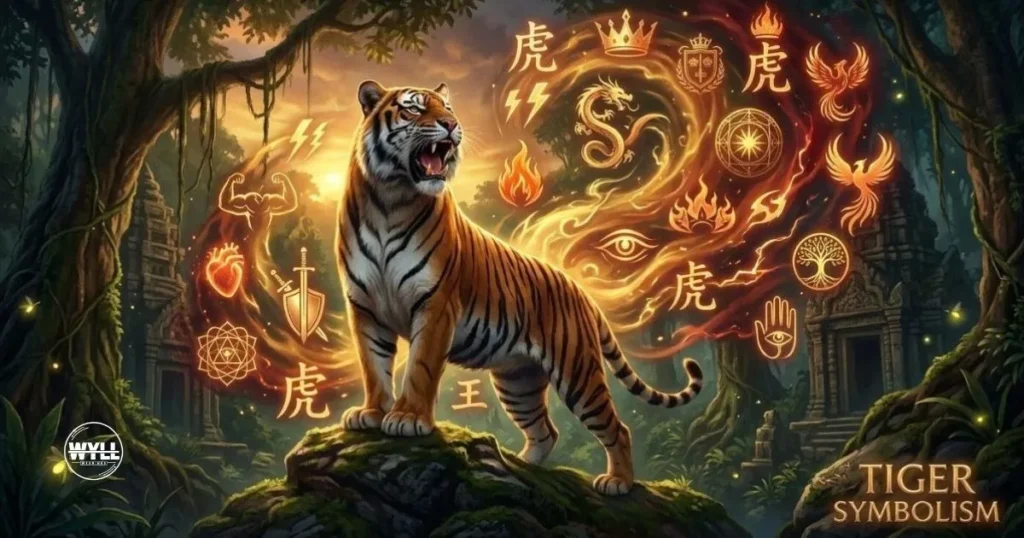
Table of Contents
Tiger Symbolism and Its Core Meaning
At its core, tiger symbolism represents strength under control. Unlike a symbol that simply suggests aggression, the tiger can communicate patience, awareness, self-confidence, independence, and the ability to act decisively when necessary. Its solitary hunting behavior has also contributed to associations with self-reliance and individuality.
The tiger can also symbolize protection and courage. Its intimidating presence has historically made it suitable for guardian imagery, while its beauty and physical power have made it an enduring subject in visual art. In modern life, people often use tiger imagery to express a strong identity without necessarily meaning violence or aggression.
Tiger Symbolism and Strength, Courage, and Power
The connection between tiger symbolism and strength comes naturally from the animal itself. Tigers are large predators with powerful bodies, strong limbs, sharp senses, and specialized hunting abilities. These physical characteristics helped shape the tiger into an enduring metaphor for physical and personal power.
Courage is another important layer of tiger meaning. A tiger image can suggest the willingness to face pressure without immediately backing down. In personal symbolism, that may mean overcoming fear, standing up for yourself, or developing confidence after a difficult period. The symbol is therefore often about inner strength, not just physical force.
Tiger Symbolism and Protection
Tiger symbolism has a strong connection with protection, especially in East Asian traditions. Historical tiger imagery could function as a guardian symbol because the animal’s frightening appearance was believed to have the power to repel harmful forces. Strength and protection became closely connected ideas.
This protective meaning still appears in modern art and tattoos. Someone may choose a tiger because it represents protecting family, defending personal boundaries, or remaining strong during difficult circumstances. In this context, the tiger is less about attacking and more about creating a powerful sense of security.
Tiger Symbolism and Independence
A tiger often represents independence because it is generally a solitary hunter. Unlike animals that depend heavily on group structures, adult tigers commonly live and hunt alone. This behavior has helped create symbolic associations with self-reliance, independence, confidence, and personal freedom.
For a person, tiger symbolism can therefore represent the ability to walk an individual path. Someone may connect with the image after becoming more confident in making their own decisions or after learning how to rely on themselves. The message does not have to mean isolation; it can simply represent having a strong sense of identity.
Tiger Symbolism in Chinese Culture
Chinese tiger symbolism has a long and complex history. Tigers have been associated with bravery, strength, authority, protection, and the ability to drive away harmful influences. Tiger imagery has appeared in painting, decorative objects, clothing, military-related symbolism, and protective traditions.
The tiger also holds an important place in Chinese cosmology. The White Tiger, or Baihu, is one of the Four Symbols and is associated with the western direction. This is a specific cosmological meaning and should not be confused with every modern image of a white tiger.
Tiger Symbolism in the Chinese Zodiac
In the Chinese zodiac, the Tiger is one of the twelve zodiac animals. Traditional interpretations commonly associate the Tiger with courage, energy, confidence, determination, and boldness. These are cultural and astrological interpretations rather than scientifically established personality characteristics.
People born in a Tiger year may encounter these symbolic associations in Lunar New Year traditions, astrology, artwork, and popular culture. Because zodiac systems have their own historical framework, Tiger zodiac symbolism should be understood as a cultural tradition rather than a universal definition of personality.
Tiger Symbolism in Korean Culture
Tiger symbolism also has a major place in Korean visual culture and folklore. Tigers may appear as powerful guardians, mountain creatures, or figures associated with strength and authority. Korean folk art sometimes presents them in a surprisingly humorous or approachable way, showing that the tiger does not always represent fear or aggression.
In Korean artistic traditions, tiger paintings can also appear alongside mountains, pine trees, dragons, and magpies. These combinations create meanings that are broader than the animal alone. The result is a symbolic language in which protection, luck, nature, power, and even humor can coexist.
Tiger Symbolism in Hindu and South Asian Traditions
Tiger symbolism in South Asia can involve power, protection, courage, nature, and divine strength. Religious art and regional traditions differ, so it is important not to treat every representation as having exactly the same meaning. The tiger can appear within stories and visual traditions that connect the animal with powerful divine or natural forces.
Durga is one important example when discussing tiger imagery in South Asian art. Although Durga is traditionally associated with a lion in many representations, museum collections also document depictions in which her mount is rendered as a tiger. This shows why the exact artistic and regional context matters.
Tiger Symbolism in U.S. Culture
In the United States, tiger symbolism is often used in a modern and secular way. Tigers appear in sports mascots, school logos, fashion, advertising, tattoos, entertainment, home decor, and branding. In these settings, the image commonly communicates toughness, confidence, speed, pride, energy, or competitive spirit.
This modern American meaning is different from historical Chinese or Korean symbolism. A sports mascot may represent team identity, while a traditional East Asian painting can contain religious, cosmological, or protective associations. Separating these contexts helps prevent modern meanings from being incorrectly presented as ancient cultural facts.
Tiger Symbolism in Tattoos
Tiger tattoo symbolism commonly represents strength, courage, protection, independence, resilience, and personal power. Some people choose a tiger after overcoming a difficult experience, while others simply connect with the animal’s confidence and wild beauty. The meaning often becomes more personal when the wearer chooses a particular pose or style.
A roaring tiger can suggest courage, defiance, or readiness to defend oneself. A calm tiger may communicate controlled strength and confidence. Black-and-gray realism, traditional Asian-inspired imagery, minimalist designs, and colorful artwork can all create different visual impressions. Surrounding elements such as flowers, mountains, dragons, moons, or waves can add additional symbolism.
Tiger Symbolism and White Tigers
White tiger symbolism has a particularly strong association with East Asian traditions because the White Tiger, or Baihu, has a specific role in Chinese cosmology. It represents the west within the system of the Four Symbols and is connected with a larger cosmological framework.
A modern white tiger tattoo does not automatically carry this exact historical meaning. Someone may simply prefer the unusual appearance of a white tiger, while another person may intentionally reference East Asian symbolism. The visual similarity does not mean the cultural context is identical, so the intention behind the design matters.
Tiger Symbolism and Spiritual Meaning
Spiritually, tiger symbolism is often interpreted as a sign of inner strength, courage, instinct, protection, confidence, and personal transformation. People may think of the tiger as an image that encourages them to trust themselves, establish stronger boundaries, or face challenges with greater confidence.
These spiritual interpretations are belief-based rather than universally proven facts. One person may see a tiger as a spiritual protector, while another may view it simply as a symbol of courage. The most meaningful interpretation usually comes from the individual’s own beliefs, experiences, and cultural background.
Tiger Symbolism in Dreams
Tiger dream symbolism can have different interpretations depending on the dream and the emotions involved. A tiger may represent fear, pressure, confidence, instinct, personal power, or something that feels difficult to control. There is no scientifically established dream dictionary that assigns one universal meaning to every tiger dream.
The details often matter more than the animal itself. A calm tiger might feel completely different from a tiger chasing someone. Likewise, seeing a tiger in a safe environment may produce a different emotional response from seeing one in a threatening situation. Dream interpretation is best treated as personal reflection rather than prediction.
Tiger Symbolism and the Meaning of the Tiger’s Stripes
Tiger stripes contribute heavily to the animal’s visual symbolism. Their bold, irregular pattern creates an impression of individuality and natural beauty while also emphasizing the tiger’s wild identity. Every tiger has a distinct stripe pattern, which makes the markings useful as a visual metaphor for uniqueness.
In tattoo design and artwork, stripes can also increase the feeling of movement and power. A highly detailed tiger with sharp contrast may feel intense, while a softer artistic treatment can make the animal appear calm or elegant. The same basic symbol can therefore communicate different emotions through design choices.
Tiger Symbolism and the Balance Between Power and Calm
One of the most interesting aspects of tiger symbolism is the contrast between power and stillness. A tiger does not need to appear aggressive to look powerful. Its quiet posture, focused eyes, and controlled movement can create a stronger impression than constant action.
This is why the tiger can work as a metaphor for controlled confidence. The message may be that strength does not always need to be loud. In everyday life, that idea can resonate with someone learning to stay calm, maintain boundaries, and act only when action is necessary.
Tiger Symbolism and Wildlife Conservation
Modern tiger symbolism also has a real-world environmental dimension. Tigers are endangered, and their populations have been affected by habitat loss, poaching, illegal wildlife trade, and human-wildlife conflict. WWF currently reports roughly 5,574 tigers in the wild, using information from the Global Tiger Forum and related conservation efforts.
This adds an important layer to how we think about the tiger today. The animal is not only a cultural symbol or tattoo design; it is also a living species that needs protected habitats and conservation support. For some people, tiger imagery carries an additional message of respect for wildlife and the importance of protecting threatened species.
Final Thoughts
Tiger symbolism remains powerful because it combines several ideas that people naturally find meaningful: strength, courage, independence, protection, resilience, confidence, and wild beauty. At the same time, its deeper meaning changes across cultures. Chinese cosmology gives the White Tiger a specific role, Korean traditions add distinctive folk interpretations, and South Asian art introduces its own religious and cultural context.
For modern readers, especially in the United States, the tiger can be a personal symbol of becoming stronger without losing self-control. It can represent a tattoo chosen after a difficult chapter, a mascot representing team pride, or simply an appreciation for one of nature’s most remarkable predators. The most accurate interpretation is always the one that respects both the cultural history of the tiger and the personal meaning attached to it. And beyond symbolism, remembering that real tigers are endangered gives the image an even deeper meaning: strength is worth protecting, too.
FAQs
Author

Ethan Carter is a search engine optimization blogger focusing on web slang, text content abbreviations, and social media implications. He creates clean, accurate, and reader-friendly content backed by using thorough research. Its purpose is to help readers understand modern online language with reliable, flexible publications.






2 Comments